
Discover what’s unique

WHAT WE DO
We at Stucki support companies to transform on three levels; individual, team and organization. We do this by customizing seminars and programs to equip and empower your leaders and teams to solve their organizational challenges. We use a unique method of experiential learning to create a safe place to test and try out new behaviours and skills. Based on our extended knowledge grown since 1984 our STUCKI Method® achieves real impact, stronger ownership, collaboration and performance.
“Empowering people is our passion.”
OUR SERVICES
Leadership Expertise
At Stucki we believe that leadership can be learned and developed. By taking a human-centric approach we encourage leaders to explore new dimensions of leadership and self-discovery.
With a focus on transformative leadership, we design action-oriented activities to develop leadership skills in a dynamic and interactive setting. The hands-on nature of these simulations promotes impactful learning, critical thinking and skill enhancement. Our seminars are customized for all leadership levels: from junior managers right up to senior executive leaders, always with the company objectives in mind.
Team Development
No two teams are the same, but we can equip them with the right tools and mindsets to unlock their potential. We empower teams to take an active role in the overall success of the organization. Through our action-oriented activities individuals learn how to foster a more collaborative and self-sufficient team environment. By facilitating a process with aspects such as orientation, trust, aligned objectives, commitment and implementation we see teams moving quickly and successfully to high-performance teams.
Organisational Transformation
Change is a deeply human process, therefore we at Stucki maintain our human-centric approach to increase the impact of the change, integrate all levels in the change process, create real ownership of the new strategy and cascade the change down from the C-suite level to the factory floor.
Alternatively, we can offer our support for self-organized teams and focus on developing skills around autonomy, decision-making and harnessing collective wisdom to promote a more agile and productive work environment.
Depending on your transformation strategy, we define clear objectives and facilitate the discussion process but don’t deliver strategy content. We help to break silo mentality and competition within the company. Through our action-oriented activities we achieve maximum alignment and collaboration between individuals and teams. Organisational change requires a cultural transformation and mindset change. We also offer ambassador trainings in resilience, sustainability and diversity.
About US
In 1984, as Robert Stucki was guiding high alpine tours in the Swiss Alps, he identified a gap between the practical requirements expected from leaders and theoretical approaches of management schools.
With his combined experience as a mountain guide and leader in an engineering company, he was a pioneer in developing action-oriented learning activities to close this gap. From this moment on Stucki Leadership and Team Development AG was founded and the concept of experiential learning was at the heart of everything the company did.
Driven by passion, dedication and innovation the company developed the tried and tested method: the Stucki Method®.
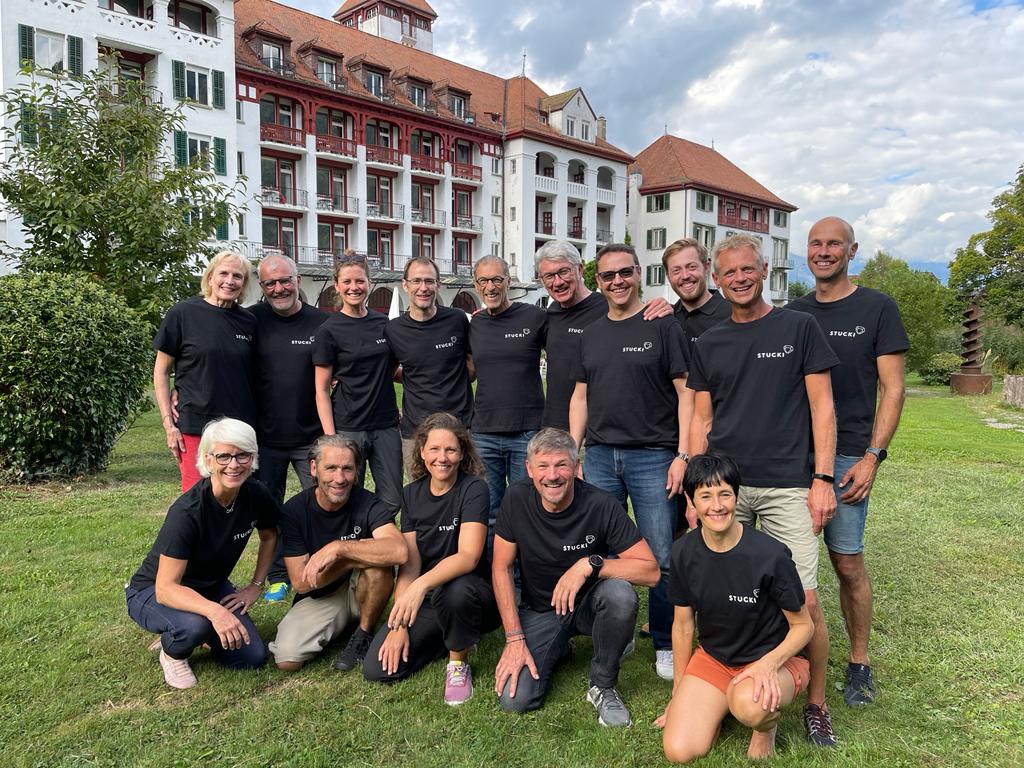
The Team
We are passionate in everything we do and always have a human-centred approach. Our diverse team of trainers demonstrate sound training, life experience and technical expertise. Infused with a large dose of empathy and authenticity they have the courage required to say the things that matter when they matter. Our Stucki culture is derived from an agile can-do attitude and deep commitment to quality and life-long learning.
Our vision
Empowering people is our passion.
THE STUCKI METHOD® – Our Approach
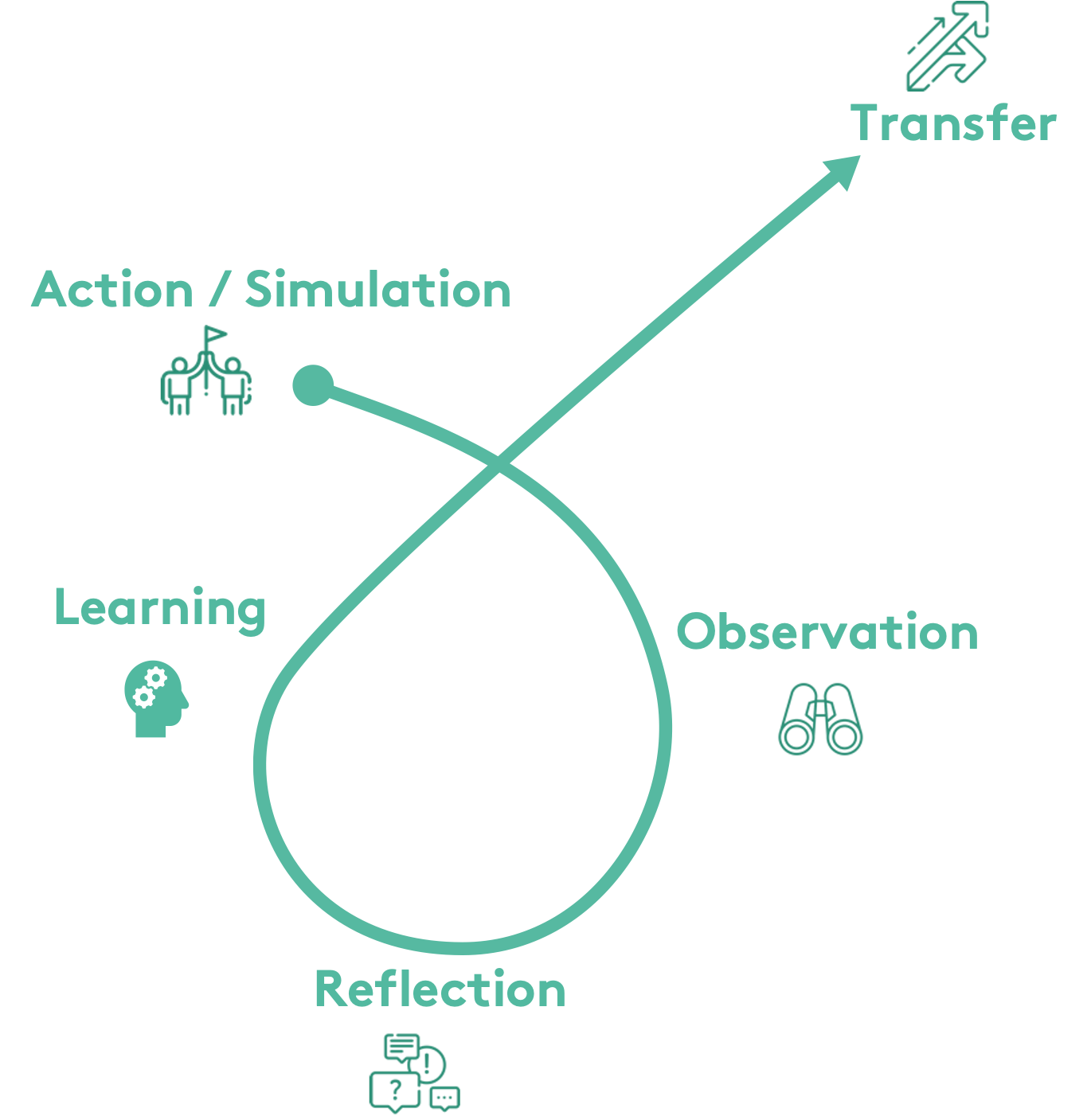
In the past 40 years, we have steadily developed a method that makes us unique today – the Stucki Method®. Built on a tried and tested approach of action-oriented learning we focus on four phases: Activity, Observation, Reflection and Transfer.
This gives our seminars a clear structure and guarantees an immersive, memorable and impactful learning that is relatable and transferable to your business challenges. Putting your learnings into action plans with real commitment and ownership from all involved is the key to our successful seminars.
Action / Simulation
We ensure a memorable experience pushing you to your limits – but never beyond.
Observation
The essential is often invisible to the eye; it needs to be observed through experience and action
Reflection
Action without reflection is just fun. With reflection it yields real, deep, substantive learning. that you can apply to business challenges
Transfer
We leverage tried and tested theoretical models to anchor learnings into actionable behaviours impacting everyday life and challenges.We use as much theory as necessary and as little as possible, with a clear focus on implementation.
Try it Out Workshop
Alongside our customized services on leadership, team development and change management, we also offer thematic services.
You want to know how we can support you and your company?
But before you decide to book one of our services, you would like to know whether Stucki is the right partner for you? We understand that and hold free Try It Out – Workshops. Why not take the opportunity to come along and get to know us?
In our Try It Out – Workshops, you will get to know our trainers and experience the Stucki Method®. This workshop will appeal to everyone who sees people and their learning ability as a key to the success of a company.
Content of the workshop
- Stucki Method®: Experience our working method for yourself – outdoor and indoor.
- A short introduction of the company Stucki, its trainers and seminars.
- Information exchange, questions on Stucki services.
- Aperitif and discussion.
- The workshop will take place in a modern, fully equipped seminar centre.
Try-it-out, a workshop to get to know the Stucki Method
Further Dates
07.03.2024 – Quellhotel Bad Ramsach, Läufelfingen (BL), German
13:00-17:30h + Aperitif
21.03.2024 – Le Castel de Bois Genoud, Crissier (VD), French
13:00-17:30h + Aperitif
03.10.2024 – Le Castel de Bois Genoud, Crissier (VD), French
13:00-17:30h + Aperitif
07.11.2024 – Boutique Hotel Schloss Hünigen, Konolfingen (BE), German
13:00-17:30h + Aperitif
WHAT OUR CLIENTS SAY
«Excellent Collaboration»
Stucki Leadership & Team Development is supporting us in a cultural transformation project. Through close collaboration, they are helping us to develop and implement a programme to strengthen our employees’ sense of belonging to our company, to orient our leaders towards the behaviours that will enable us to achieve our strategic objectives and to develop their leadership skills. I look forward to continuing this excellent collaboration with Stucki Leadership & Team Development and highly recommend their services.

Philipp von Büren
Cendres + Métaux Group, CEO
«Professional partner with a pragmatic and impactful approach.»
Stucki Leadership & Team Development has been supporting us for many years in the development of our managers and in the cultural transformation of our company. Stucki is a very professional partner with a pragmatic and impactful approach. The trainers are experts in their field and were able to quickly create a bond of trust and openness with our employees. I would highly recommend Stucki to any company wishing to work on leadership, team development or cultural transformation.

Alexander Hirter
ETEL, CEO
«impressed by the flexibility and specific knowledge of the trainers.»
One of the challenges facing SKAN is the management of the extreme growth. Stucki very effectively supported and assisted the management in the development of the team and the “strategy 2025″. The Stucki trainers quickly grasped our challenges, the cultural environment and the individuals involved in the process. They helped and enabled the managing executives to focus and develop into a “high performing team”. In designing the team development process and the strategy workshops, I was impressed by the flexibility and specific knowledge of the trainers. When processes came to a standstill, they adapted the program to our needs in a quick an agile way. I found the trainers empathetic, grounded and professional. The series of workshops always took place in a constructive, respectful and trusting atmosphere. We will gladly continue our cooperation with Stucki, including support in the area of leadership development Training.

Thomas Huber
Skan AG, CEO
«I see Stucki’s method as a groundbreaking way to focus people’s energy.»
Stucki provided us with excellent and competent support both in merging teams and in the context of a major change project. The new teams were immediately capable of action and harmonized well. Stucki’s action-oriented approach met with a very good response and a high level of acceptance from all superiors and employees across the hierarchy. Results were quickly visible. The training and the subsequent visible implementation of measures were the basis for stability, focus, security and optimism in the supported teams. I see Stucki’s method as a groundbreaking way to focus people’s energy and motivation and to show them new ways. Stucki convinces through tasks that are specifically geared to the situation and through professional trainers with the gift for clear feedback.

Max Gerber
Baloise Bank SOBA, Leiter Human Resources (former)
«Stucki is by far one of the most comprehensive outdoor leadership providers.»
In my various Talent & Leadership roles I have had the pleasure to work with outdoor experiential leadership providers around the world.
Stucki is by far one of the most comprehensive outdoor leadership providers. The team quickly listened to our needs, aligned to, and incorporated, our goals and values into our event design and activities. This brought to life, in an outdoor setting, universal leadership challenges which participants could grapple and learn about, in a safe and fun environment. Through thoughtfully facilitated debriefs the participants are able to readily apply their learnings to their day to day corporate leadership challenges.
Thank you Stucki for bringing leadership theory to life.
Rhonda E. Fletcher-Leonetti
SIKA, Talent & Learning Development Manager (former)
«I can strongly recommend Stucki to any company.»
We have used Stucki very successfully in various cases for Team-Building and Team-Development in our global Finance-Organization. A great combination of customer specific topics and creative Stucki Team-building exercises.
I can strongly recommend Stucki to any company.

Jörg Weis
Bosch, Senior Vice President Accounting (former) / Lead of HR-Transformation
«Stucki stands out.»
Among the many providers of leadership training, team building and organizational development, Stucki stands out. Their approach of task-oriented learning and reflection guarantees the relevance of the content and ensures the transfer to everyday management demanded by companies and desperately sought by those responsible for training. Stucki has thus brought Ricola’s management team quite a bit further forward.

René Schori
Ricola AG, Director Global HR (former) / Chief Human Resources Officer
«The Stucki team did an excellent job.»
The Stucki team did an excellent job of designing and moderating our management workshop in a way that was tailored to our needs and our management culture. The healthy mix of theory and practice was very effective for our managers. Several months after the seminar, a follow-up was conducted. We were pleased to see that the managers were consciously implementing what they had learned and their personal transfer goals in their day-to-day management.
Ruth Maurer
Eidgenössisches Institut für Metrologie METAS, Head of Human Resources
«It was another great collaboration for which I am very grateful.»

Jean-Christophe Deslarze
ABB Ltd., Chief Human Resources Officer, Member of the Group Executive Committee (former) / ADECCO, Chairman of the Board (current)
«We became much more efficient as a team»

Christian Biland
Migros Ostschweiz, Managing Director (former) / Migros Zürich, Chairman of the Board (act.)
«Stucki AG knows how to respond to our wishes/needs»
Monika Moser, Daniela Hunziker
Swiss Post Solutions AG
«Robert Stucki and his team make it possible to find answers to these fundamental questions»

Alain Ritter
Georg Fischer Piping Systems, Head Human Resources (former) / Consultant and Coach (act.)
«Stucki employees are talented, committed, honest and very pragmatic»
Anton Bleikolm
SICPA Holding SA, COO (former) / Orell Fuessli Holding AG, Member of the Board (act.)
«This course gave me the opportunity to deeply understand my strengths and weakness»

Waheed Zahran
Palestinian Hydrology Group (former) / Trainer and Business Consultant (act.)
«They were able to propose innovative solutions»
Impactful program design starts with asking powerful questions. Stucki’s team consisting of Robert and Bernard, did exactly that, and this helped us clarify and articulate the true objectives for the program. Their contribution to design and development was invaluable too. They were able to propose innovative solutions that were founded in Adult Learning methodology and Mind-Brain Research. Their pedagogical approach was a breath of fresh air from the commoditized offerings one sees in Learning these days. They followed it up with superlative delivery, facilitation, and infrastructure management.
I look forward to continuing our association with them going forward, and have no reservations in recommending their services.
Prasad Swaminathan
ABB, SVP and Global Head of Talent & Learning (former) / ADECCO Workforce Solutions, Global Head of HR (act.)
Contact
Feel free to reach out to us for any inquiries or requests you might have. We are here to assist you and look forward to hearing from you.
Headquarter
Stucki Leadership & Team Development AG
Moosweg 36
CH-3645 Thun-Gwatt
Tel. +41 33 334 13 00
info@stucki.ch
Romandie
Stucki Leadership & Team Development AG
Rue du Casino 3
CH-1400 Yverdon-les-Bains
Tel. +41 24 423 83 83
info@stucki.ch